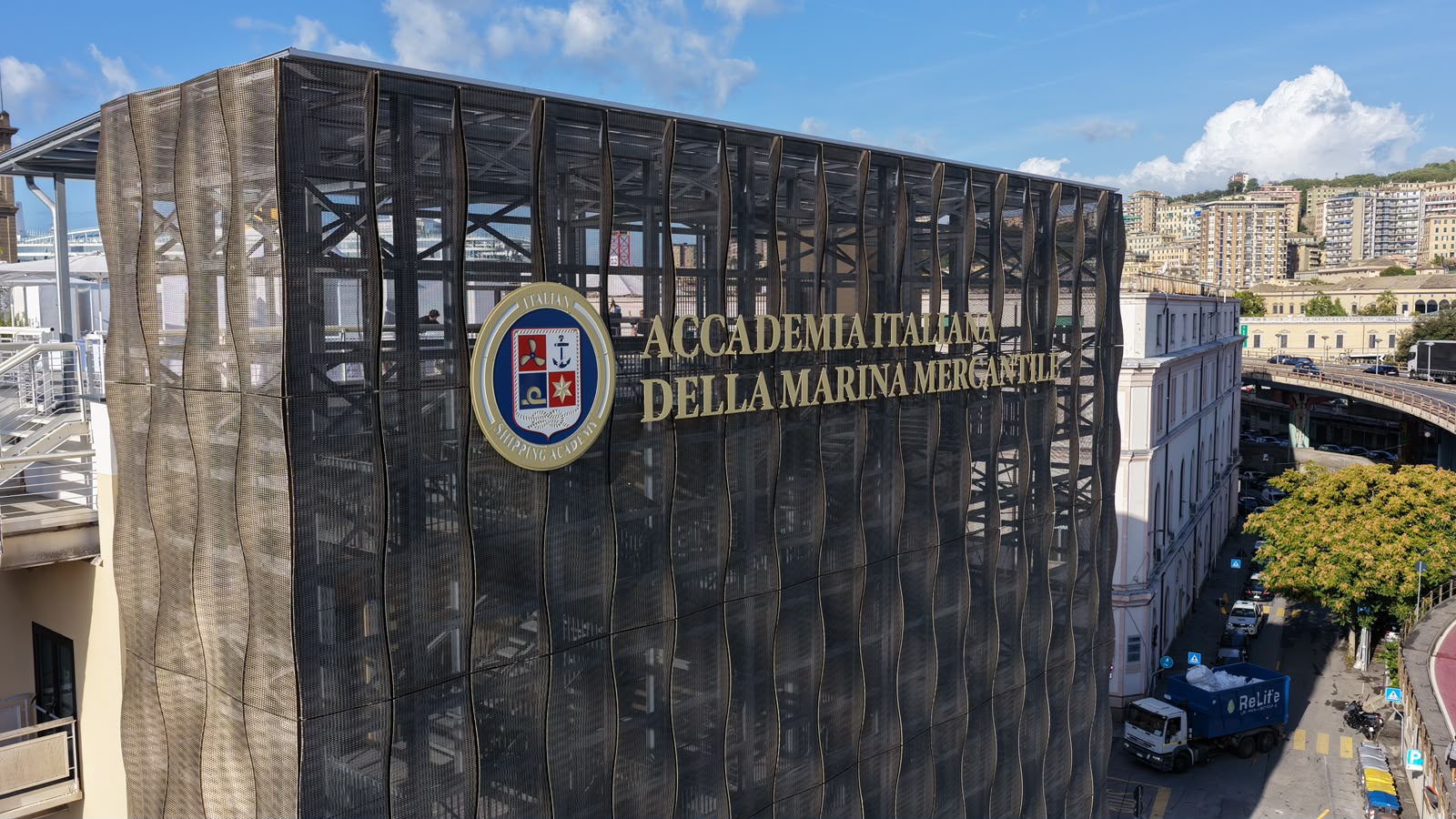
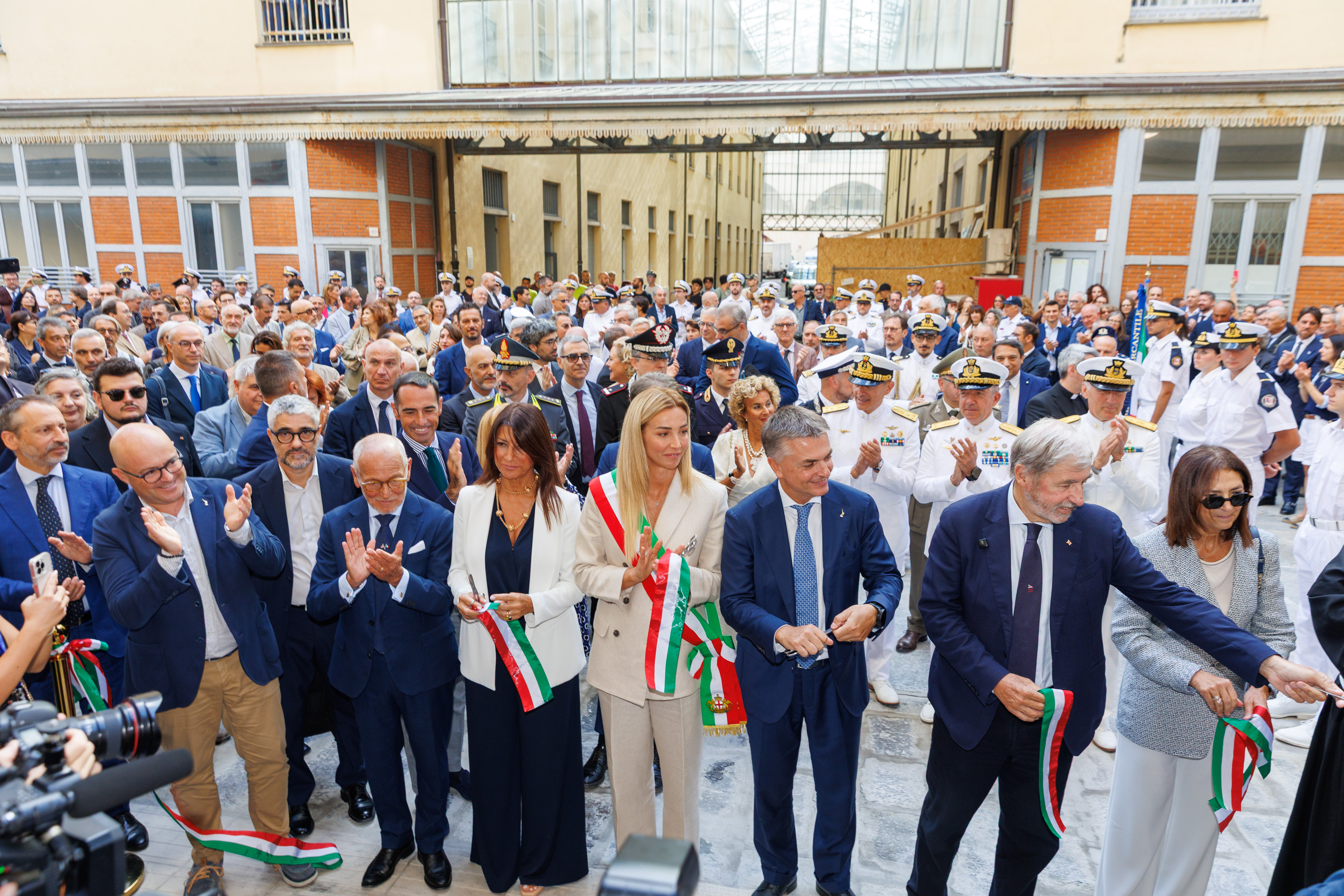
Genoa, 18 September 2026 — The Italian Shipping Academy (Accademia Italiana della Marina Mercantile), Italy’s largest ITS Foundation dedicated to sustainable mobility, this morning inaugurated its new headquarters at Palazzo Tabarca, in the heart of Genoa’s historic port. A landmark date for the Academy and for the entire Italian freight and passenger transport sector, the ceremony was further distinguished by the conferral of the Medal of the President of the Italian Republic in recognition of the initiative. Among the attendees: the Deputy Minister of Infrastructure and Transport, Hon. Edoardo Rixi; the Undersecretary of State for Education and Merit, Hon. Paola Frassinetti (via video link); the President of the Liguria Region, Marco Bucci; the Mayor of Genoa, Silvia Salis; Admiral Sergio Liardo, Commander General of the Italian Coast Guard – Harbour Master Corps; and Rear Admiral Flavio Biaggi, Commander of the Northern Maritime Interregional Command. The inauguration also featured the blessing of the new premises by His Excellency Archbishop Marco Tasca of Genoa.
The new Palazzo Tabarca headquarters is the result of a shared institutional effort between the Foundation and both local and national authorities. In September 2024, a formal agreement was signed between the Municipality of Genoa and the Foundation for the assignment of a portion of the historic Darsena building. The structure — spanning approximately 4,800 square metres across four floors — is part of a broader urban regeneration project under Italy’s National Recovery and Resilience Plan (PNRR), with over €18.5 million in government funding allocated to the restoration of the entire Tabarca–Metelino complex. An additional approximately €10 million in PNRR funds has been earmarked specifically for the development of advanced laboratories available to the entire national maritime cluster. The total public investment, including funds allocated for new training programmes, amounts to approximately €40 million, and delivers what will become the most advanced public maritime simulation centre in the Mediterranean — the product of collaboration between the Municipality of Genoa, the Italian Government, the Liguria Region and the Foundation itself, in line with the European objectives of the PNRR. The facility, spread across the four floors of Palazzo Tabarca, will soon accommodate the Academy’s current 1,050 students under a single roof, and also provides 14 new apartments for 64 resident students. Thanks to close partnerships with leading companies in maritime simulation — including Cetena-Fincantieri, Kongsberg, Wärtsilä and GTT — logistics (CHESSCON, Simodar Training Solutions, Leonardo Informatica) and the railway sector (including Transurb), the Academy’s new headquarters features a state-of-the-art, resilient technological ecosystem for advanced professional training in sustainable mobility. It comprises 18 simulation platforms (largely integrated with one another and/or with real onboard systems such as ECDIS units supplied by CAIM and loading programmes developed by NAPA) and 2 applied science and technology laboratories focused on decarbonisation, equipped with systems for the study of pneumatics, hydraulics and mechatronics (FESTO and SIEMENS systems). The simulation systems span the full range of maritime operations — from cargo shipping and cruise vessels to port cranes, offshore installations and offshore support units — enabling comprehensive, future-ready training across all sectors of logistics, transport and port operations.
 Statements
Edoardo Rixi, Deputy Minister of Infrastructure and Transport: «Palazzo Tabarca is an investment in the future of the Italian maritime system. Here we convert public resources into training, innovation and skills — the very tools needed to enhance the competitiveness of our port and logistics network. Genoa has an extraordinary maritime heritage, but it cannot rest on past achievements: it must continue to invest in people, technology and the capacity to manage the sector’s transformation. With this facility, we take a concrete step in that direction. Our goal is clear: to strengthen Genoa as Italy’s maritime capital and to establish it as an ever more authoritative reference point for the Mediterranean. Because if we want Italy to regain its leading role in international trade and seafaring, Genoa must be at the heart of that challenge».
Paola Frassinetti, Undersecretary of State for Education and Merit: «The Academy represents a flagship of Italy’s national ITS Academy system and a centre of excellence in developing the skills demanded by the maritime economy. The reforms promoted by the Government — including the 4+2 technological-vocational pathway and the restructuring of the ITS Academy framework — are delivering tangible results: in the academic year just begun, enrolments have doubled compared to the previous year, fully meeting the targets set under the PNRR».
Marco Bucci, President of the Liguria Region: «The inauguration of Palazzo Tabarca is a concrete investment in the future of Liguria and the Italian maritime system. The sea and the port are fundamental to Genoa’s identity and economy, but continued growth requires above all skills, training and innovation. We began work on this project over five years ago, and today this major restoration hands us a training centre that is unique in Italy and in Europe — with cutting-edge technologies and simulators that will allow students to train in conditions that closely replicate real-world operations. This is an extraordinary opportunity to give further momentum to the cornerstone of our regional economy, while offering young people new prospects and building the skills the blue economy urgently needs. The professionals who leave this building will lead our maritime economy in the years ahead, reinforcing Genoa’s role as Italy’s maritime capital and a key reference point in the Mediterranean».
Silvia Salis, Mayor of Genoa: «My thoughts are with the young women and men who will enter these halls eager to learn a trade, carrying the questions that come with choosing one’s future. I hope that here in Genoa they find the opportunities and the confidence they need to build their independence and their lives. The Academy has worked for over twenty years to guide students towards skilled professions, maintaining close ties with industry. With the new premises at Palazzo Tabarca, this work gains the space and tools to grow further, right at the heart of our maritime heritage. Seeing a building in the Darsena welcoming young people who will study and spend part of their days here is a source of pride for the whole city. I thank all those who have contributed to this result and those who, every day, put their expertise at the service of students: it is through their work too that Genoa’s bond with the sea continues to offer prospects to new generations».
Admiral Sergio Liardo, Commander General of the Italian Coast Guard – Harbour Master Corps: «The Shipping Academy represents a winning model of professional training — one that reconciles the demands of a constantly evolving market with the essential preparation of seafarers, with positive consequences for maritime safety and the protection of human life at sea, which are the core mission of the Coast Guard».
Rear Admiral Flavio Biaggi, Commander of the Northern Maritime Interregional Command: «The partnership between the Italian Navy and the Foundation of the Italian Shipping Academy — reinvigorated by our recent cooperation agreement signed last May — stems from the shared understanding that technological advancement and a culture of maritime safety are a common heritage. Sharing teaching methodologies, training standards and access to advanced simulators is the only way to keep Italy’s national system at the forefront of global shipping and maritime defence».
Matteo Paroli, President of the Port System Authority of the Western Ligurian Sea: «The transformation of ports and the maritime economy necessarily depends on skills. We can invest in infrastructure, digitalisation, automation, energy and new technologies — but none of these transformations delivers its full potential without the professionals capable of managing them. Training is therefore not a peripheral element of development: it is one of its essential preconditions. The challenge also lies in conveying to young people the real dimensions of maritime work today, moving definitively beyond images that belong to the past. The contemporary port is an advanced industrial and technological system in which increasingly specialised competencies, safety, innovation, digital capability and operational skills intersect. It is a world that offers high-profile career paths and which, precisely as it changes rapidly, has a growing need for new talent. The Academy embodies this transition by combining the maritime culture that runs deep in Genoa’s history with the tools needed to build its future. Even the choice of the new location — adjacent to the port basin — carries concrete meaning: training, business, technology and employment in a single place. This proximity is what we must continue to strengthen, because the most effective way to bring a new generation closer to the sea is not simply to tell them what the port has been, but to equip them to become protagonists of what it will be».
Eugenio Massolo, President of the Foundation: «The Academy’s new headquarters speaks to its past — more than 20 years of active, rewarding history — and to its future. We are the bridge between these two moments in time, and we are proud to deliver to Italy an instrument of absolute excellence in professional training, one capable of shaping the professional profiles the sector will need — including those that do not yet exist».